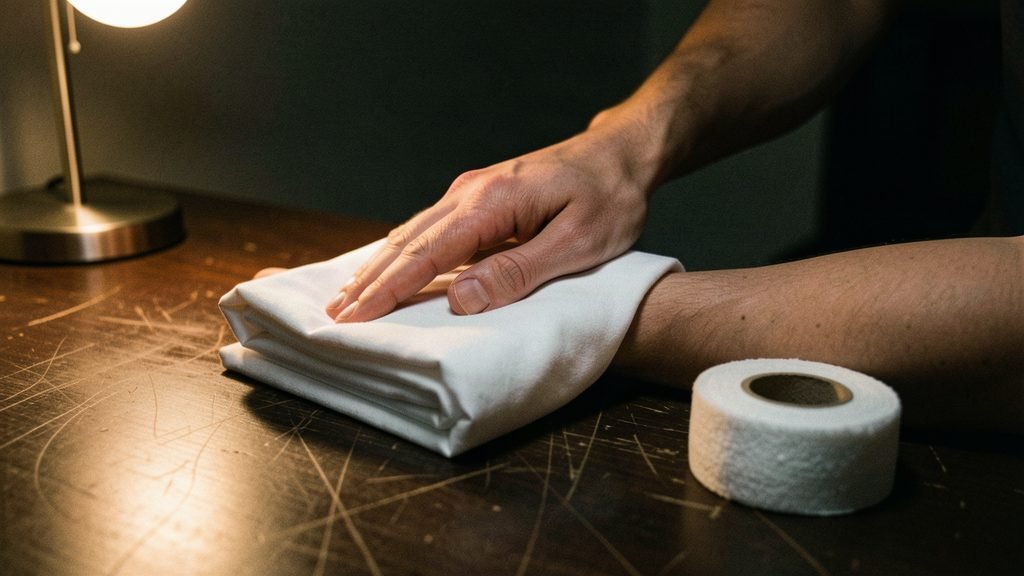
The 15 minutes that save a life
Most people lift the cloth to check. That one habit is how someone who was going to live, doesn't. This is the pressure rule, and where the books contradict each other.
If someone is bleeding badly, the single most useful thing you can do costs nothing and requires no training: press hard on the wound and do not lift your hand for fifteen minutes. Not five. Not "just a peek". Fifteen.
Where There Is No Doctor — the manual Hesperian publishes free for health workers in places with no doctor — states plainly that direct, firm pressure stops almost all bleeding, including heavy bleeding. The failure mode it warns about is the one everybody does instinctively: lifting the dressing to see whether it is working. That tears off the clot that is forming and restarts the bleed, so you begin again from zero.
The detail that makes it work in practice: if the cloth soaks through, do not remove it. Add more cloth on top and keep pressing. Pressure stays continuous, and the clot underneath stays undisturbed.
Where the books disagree — and which one to follow
This is the part most guides smooth over, and it matters. On tourniquets, the sources do not agree:
- Older civilian texts, including Where There Is No Doctor, call a tourniquet a last resort, and older first-aid books told people to loosen it every few minutes.
- Current military trauma guidance — the US Army's Emergency War Surgery — says the opposite: apply a tourniquet early rather than allow ongoing blood loss, place it high on the upper arm or thigh, and do not loosen it.
Follow the newer guidance if the bleeding is from a limb and pressure is not controlling it. The reasoning is physical: on the forearm and lower leg the vessels sit between two bones and cannot be compressed, so a tourniquet there can fail, while the upper arm and thigh compress against a single bone. If it is still bleeding, add a second tourniquet directly above the first — do not accept the loss and do not take the first one off.
Around two hours of tourniquet time carries little risk of permanent damage, which is why the modern advice is to stop worrying about the limb and stop the bleeding. Document the time you applied it.
What not to do
The old field remedies are actively lethal. Never pack dirt, coffee grounds, kerosene or lime into a wound — they cause severe infection including tetanus. Never cut a snakebite and never suck at it. Never put butter, oil, ice or toothpaste on a burn.
Do this this week
- Put a pressure dressing and a proper roller bandage in the car and the kitchen, not just a box of assorted plasters.
- Practise the 15-minute hold once, on your own forearm, with a timer. It is far longer than it feels.
- Learn the two pressure points for a limb bleed you cannot compress directly, on a course rather than a video.
The Winter Grid-Down Playbook covers heat, water, food, sanitation, power, medical, comms, security and recovery — in threat order, with the numbers. 43 pages, $27 CAD.
See the kits →