You are storing about a tenth of the water you need
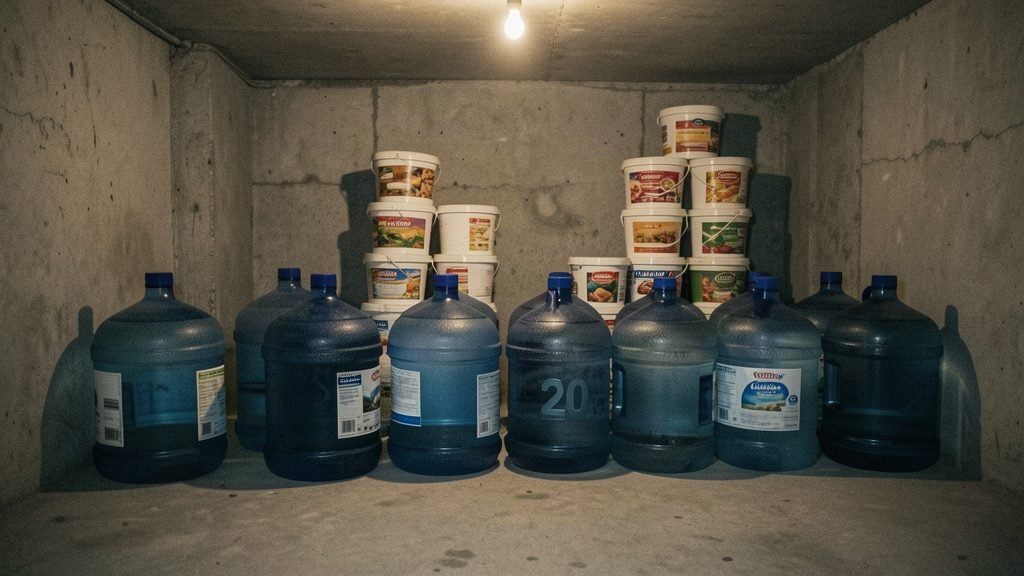
The eight jugs in the photo look like a serious stockpile. For a family of four it is nine days — and most households have less than a quarter of it.
Picture the water in your house right now. If it is a case of bottled water in the basement and a few jugs in the fridge, you have somewhere between 10 and 25 litres — and that is the number the rest of this article is about.
The planning figure comes from Cresson Kearny's Nuclear War Survival Skills, published free by the Oak Ridge National Laboratory authors and still the standard reference for shelter planning: about 15 US gallons per person for a two-week shelter stay — roughly 57 litres, deliberately generous so that some remains if the danger lasts longer. In hot weather with a crowded shelter he puts drinking water alone at four to five quarts per person per day.
Run the arithmetic on a household rather than a person, which is where the plan usually falls apart:
- 1 person, two weeks: 57 L — about 2.8 of those 20-litre containers
- 2 people: 114 L — about 5.7 containers
- 4 people: 227 L — about 11.4 containers
- 6 people: 341 L — about 17 containers
Now the photo at the top of this page: eight 20-litre containers is 160 litres. That is a genuinely respectable stockpile and it is about 2.8 times one person's two-week requirement — but for a family of four it is 9.9 days. Nine days is not nothing. It is also not two weeks, and day ten is when people start doing dangerous things.
The water already in your house
Before buying a single container, count what you own. Cody Lundin's When All Hell Breaks Loose makes the point that most homes are already holding tens of gallons nobody counts:
- The water heater: 151 litres (40 US gallons) in a typical tank — drinkable, and already connected to a tap.
- The toilet tank — not the bowl. Clean water, roughly 6 to 12 litres per tank.
- The bathtub. Fill it the moment supply is interrupted. This is free buffer.
- The washing machine and any plumbing you can drain.
Storing it without it going bad
Kearny's method is unglamorous and works: one scant teaspoon of ordinary household bleach per 10 gallons when you fill the container, and boil anything suspect for at least ten minutes before drinking. Rotate what you store. Write the date on the container.
Two rules that are easy to get wrong and matter:
- Never ration drinking water unless officials tell you to. That is FEMA's instruction, and the reason is that dehydration incapacitates you long before hunger does — a rationed, weakened person cannot do the work of surviving.
- Never drink urine or sea water raw. Both add salt or urea to a body that is already short of water and accelerate the dehydration. They are only usable distilled, as drinking water — and the energy cost of distilling them is usually a bad trade.
Do this this week
- Count what you already have, in litres, then subtract it from 57 L x the number of people in the house.
- Photograph the label on your water heater and note the tank size — that is your largest free reserve.
- Buy one 20 L container per person per fortnight of coverage you are missing, and date them as you fill.
The Winter Grid-Down Playbook covers heat, water, food, sanitation, power, medical, comms, security and recovery — in threat order, with the numbers. 43 pages, $27 CAD.
See the kits →