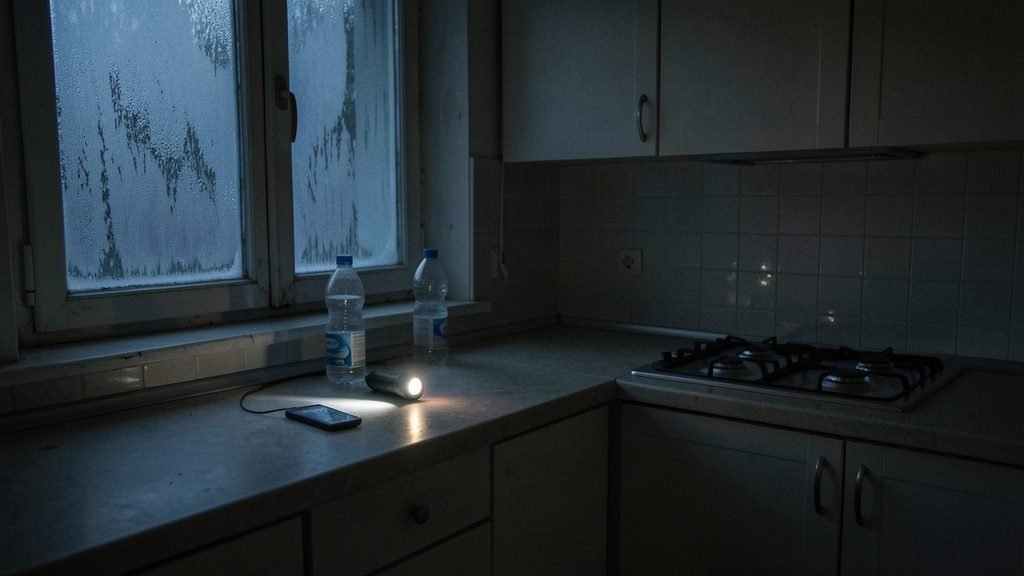
It is one hour in and I have nothing
The ice storm took the grid down at 6:40 p.m. I am not prepared. This is the first 24 hours, hour by hour — including the two things that nearly killed my neighbour, and the one thing I did in the first hour that I will never skip again.
The lights flicker twice and go out. My phone is at 34 percent. My first thought is not this could be days — it is the power will be back before midnight. Amanda Ripley interviewed around nine hundred survivors of the World Trade Center attacks and found the same thing in almost all of them: in the first minutes of a disaster people do not panic, they under-react. The average survivor waited roughly six minutes before starting down the stairs, with the building visibly burning.
So I do what people do. I sit down and wait to be told it is real.
Nothing comes back. The house is quiet in a way I have never heard before — no fridge hum, no furnace fan. It is late November and it is already 4 °C outside.
I go looking for a torch. I have one, in a drawer, with dead batteries in it, because I took the good ones for a toy at some point and never replaced them. I use the phone instead, which means I am spending the one thing I actually cannot replace.
This is the mistake of the entire night: my light is my phone, and my phone is my only light, my only clock and my only contact with the outside world. It is dead by hour six.
I do the one thing right all evening, and I do it almost by accident. I turn on the tap to see if we still have water — and we do. So I fill the bathtub, the kettle, two pots, a bucket and every water bottle in the recycling. Then I fill the two 4-litre juice jugs.
It feels stupid while I am doing it. It looks ridiculous. It is the reason we drink on day four.
Why it matters: municipal pressure does not stop the moment the power does. It fades as the pumps and towers run down, and once it is gone, it is gone — you cannot go back and fill a jug at hour twelve. FEMA's guidance is one gallon per person per day, and it is explicit that you should never ration drinking water unless officials tell you to, because dehydration takes you out of the game long before hunger would.
We are two adults. That is roughly 3.8 litres a day for drinking alone, more with cooking and washing. My half-case of sparkling water is 3 litres — under one day.
The house starts to cool. The thermostat is useless: a gas furnace still needs electricity to run the fan, so a power cut means no heat even though the gas is fine. This surprises me and it shouldn't have. I have lived here eleven years and never once thought about it.
My neighbour knocks. He has a battery radio and he has already heard the number: a wide-area ice storm, lines down across three counties, and no estimate. He also tells me he has wheeled his barbecue into the garage to cook and to warm the space up.
That is the single most dangerous thing anyone did that night. Never run a generator, a camp stove or a charcoal grill indoors, in a garage, or in any space attached to the house. Carbon monoxide is odourless, and its early symptoms — headache, nausea, tiredness — read as flu without a fever, so people sit in it rather than getting out. Ready.gov lists generators among the leading causes of CO deaths after a storm, and the reason is always the same: the enclosed space felt safer than the cold.
I told him to wheel it out to the driveway. He did. That is the whole reason this story continues — and it is the one part of the night I got right.
Dark by five. I light one candle in a jar and put it on a metal tray, because a candle is an open flame in a house I cannot see in, and I have a gas line and a boiler in the basement.
We eat cold food standing up: crackers, cheese, an apple each. It is fine. Nobody is starving on day one; the food problem is not calories, it is that almost everything I own requires a hob or an oven, and I cannot use either of them without power or a barbecue.
The phone dies at 9:20 p.m. From that point on I have no clock, no news and no torch.
I do have one workaround, and it is a good one: the car radio. I sit in the car on the driveway, engine off, listening to a local station that is running off a generator. Ten minutes, a few times over the evening, engine on briefly to top the battery. It is my only information source all night. It costs me almost nothing and it is the reason we know the following morning that this is measured in days. If I had run the engine in the garage instead of on the driveway, that would have been the CO mistake, twice in one night.
It gets genuinely cold — the house falls to about 12 °C indoors and keeps going. We do what the books say without having read them: all three layers, hats indoors, and we stop moving around the house to close off the two rooms we are not using and heat one.
I check on the elderly woman two doors down. She is fine, better prepared than us, and has a gas cartridge heater and a wind-up torch, and she is very polite about the fact that I have brought her nothing useful. Ripley's largest finding is that the health of a community after a disaster tracks the health of that community before it — the people who pull each other out are the neighbours who already knew each other. I have lived next to this woman for eleven years and this is the longest conversation we have ever had. That is a failure of preparation too.
We sleep in one room, on the floor, in every item of clothing we own, with the dog between us because a dog is 30 kilograms of body heat and nobody says that out loud but everybody does it. I sleep badly. Not because of the cold — because of the noise. The house has no hum, and the silence is louder than traffic ever was.
At 4 a.m. I take stock by torchlight, on paper, because I have finally understood that I do not know what I have. Water: roughly 26 litres, mostly in the bathtub, which makes the bathroom unusable and is a problem I have not thought about yet. Food: cold, about four days if we are careful, three if we are not. Light: none. Heat: none. Information: a car radio with a quarter tank of fuel. Cash: eleven dollars. My phone is dead and the nearest charger that works is somewhere past three counties of downed lines.
What actually saved him
- Filling every container in the first two hours while the water pressure still existed. Nothing else that night mattered as much.
- Not cooking on the barbecue indoors. Carbon monoxide is odourless and its symptoms read as flu — the mistake is always made because the enclosed space feels warmer.
- The car radio. The engine is not running, so it is almost free, and it is the only reason we know on day two that this is measured in days rather than hours.
- Staying put. The roads are glass, and the first car I saw leave the street ended up sideways in a ditch, which would have made two people into casualties instead of inconvenienced.
- Knocking on the neighbour's door. Social capital is a prep item and it is the only one you cannot buy on the day.
What he should have had on day zero
- A torch per person and a spare set of batteries — not a phone.
- Enough stored water for three days before this started, rather than a case of sparkling water.
- A battery or hand-crank radio, so information does not depend on a car.
- A power bank, charged, that lives in a drawer and is never borrowed.
- Some cash in small notes. The one shop open in town was cash only.
- Food that needs no cooking: the crackers were luck, not a plan.
- FEMA Ready.gov — Water: one gallon per person per day, and never ration drinking water
- FEMA Ready.gov — Power outages: what to do and what to expect
- FEMA Ready.gov — Generators: carbon monoxide is the leading hazard after a storm
- FEMA Ready.gov — Build a kit
- American Red Cross — Survival kit supplies
- Nuclear War Survival Skills — water requirements and storage (free full text)
- The Unthinkable — Amanda Ripley, on normalcy bias and the milling ritual
Neither was I. The advantage is not being the person with the bunker. It is being the person who did the four cheap things before the ice came.
See the kits →